Certificate of Authenticity for Art and Collectibles (Free Download and Examples)
The edition sold out in two hours. Now the artist has 47 buyers waiting for their certificates — each one needing the correct item number, the right dimensions, and a reference code that matches the piece they purchased. A Certificate of Authenticity for art and collectibles isn't issued once to a graduating cohort; it's issued once per object, and every single one is different.
Why Art and Collectibles Need These
Without a certificate, a buyer has no document that travels with the work if it's ever resold. Private collectors and gallery clients routinely ask for certificates before completing a purchase — the absence of one raises immediate questions about provenance that are difficult to answer after the fact.
Buyers use these certificates in concrete ways. They attach them to insurance valuations, include them in estate inventories, and present them to auction houses when consigning works. For limited-edition prints, the edition number on the certificate is the only thing stopping a buyer from claiming their copy is rarer than it is.
The certificate also protects the maker. A signed, numbered document on file gives artists and studios a reference record if disputes arise about whether a piece is genuine or how many were produced.
What Goes on the Certificate
| Field | Required | Notes |
|---|---|---|
| Issuing authority | Yes | The artist, studio, or authentication body — this is the entity making the claim of authenticity |
| Item title | Yes | The work's full name as it will appear in any future provenance record |
| Medium / materials | Yes | Buyers and insurers need this; "oil on linen" vs "giclée on cotton rag" affects both value and care |
| Dimensions | Yes | Height × width (× depth for sculpture); establishes physical identity of the specific object |
| Year created | Yes | Ties the work to the artist's catalogue for that period |
| Edition number + size | If editioned | Must include both — "No. 8" alone is meaningless without "of 30" |
| Serial / reference number | Recommended | Links this certificate to your own records and allows future verification |
| Artist / maker signature | Yes | The physical or digital signature that makes the document legally meaningful |
| Date of issue | Yes | Establishes when the authentication was made |
| Authentication method | If applicable | Name the third party, hologram serial, or registry where this can be verified |
Sample Wording
For wording that covers formal, casual, and industry-specific variations in depth, the Certificate of Authenticity wording guide has full examples with annotations.
A ceramicist issuing individual certificates for a sold-out limited run:
This certifies that the vessel designated Ash Series No. 14 of 20 — stoneware, wood-fired, height 28 cm — is an original work made by Faridah Zulkifli in her studio in 2024. The piece bears the artist's impressed mark on its base. Certificate reference: FZ-2024-014.
A gallery co-signing a certificate for a painting sale:
This Certificate of Authenticity confirms that Harbour at Dusk, oil on linen, 91 × 122 cm, created by Mei-Lin Soh in 2023, is an original work. This certificate has been issued by the artist and authenticated by Straits Fine Art. No reproduction rights are conveyed.
A studio issuing certificates for a signed limited-edition print series:
Meridian Series No. 3 is an authentic limited-edition print, numbered 47 of 250, produced by Foundry Press using archival pigment inks on 310gsm cotton rag. This certificate bears the studio seal and the artist's signature and accompanies the work as permanent proof of its edition status.
Templates for Art and Collectibles
Maroon Quality Stamp Certificate of Authenticity
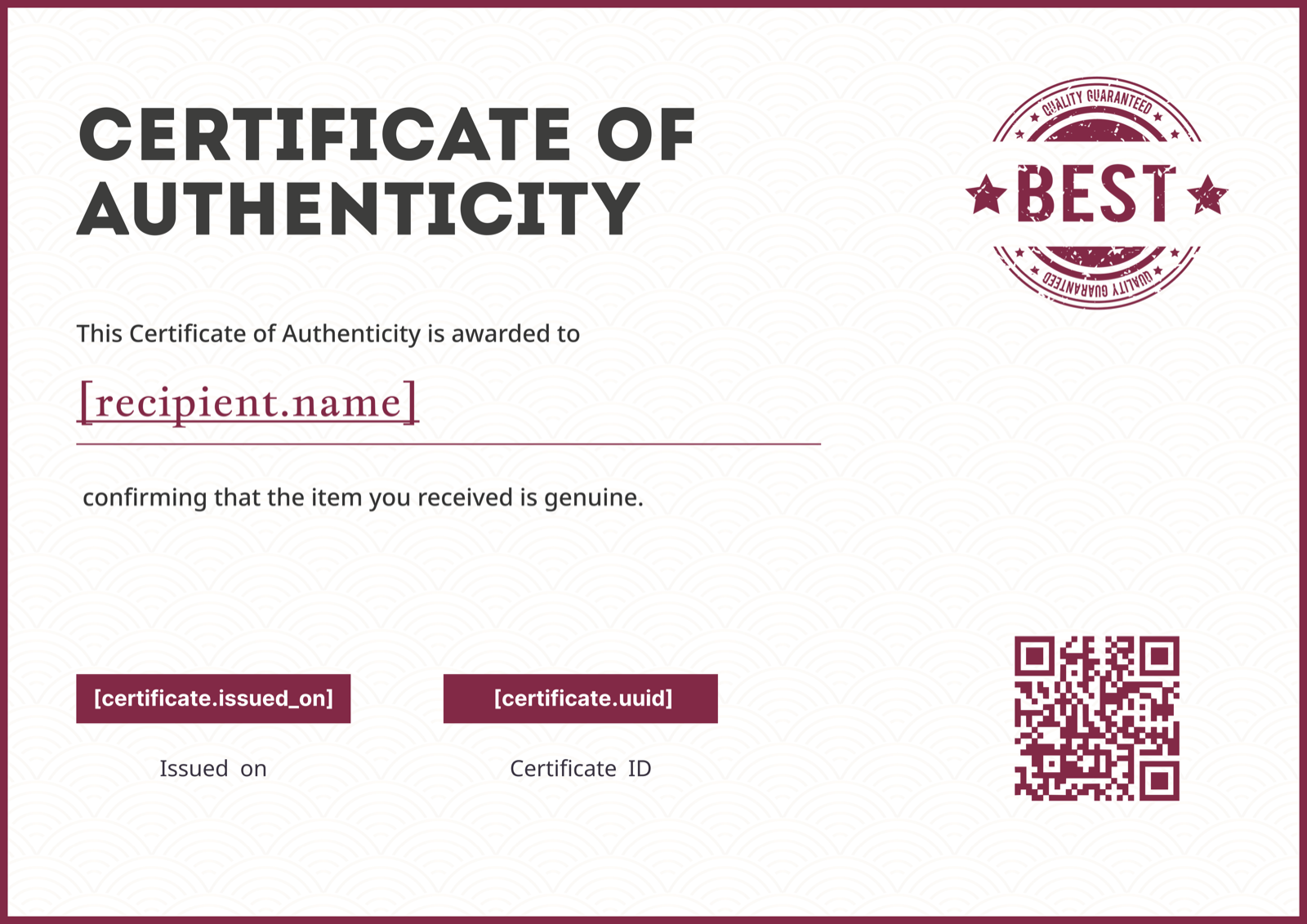
The stamp badge element does a lot of work here — it visually signals "verified" in a way that plain typography alone doesn't. Good fit for product brands and studios that want the certificate to read as a quality document rather than a fine art provenance record. Browse the full Certificate of Authenticity template gallery for more options in this style.
Minimalist Blue Accent Portrait Certificate of Authenticity
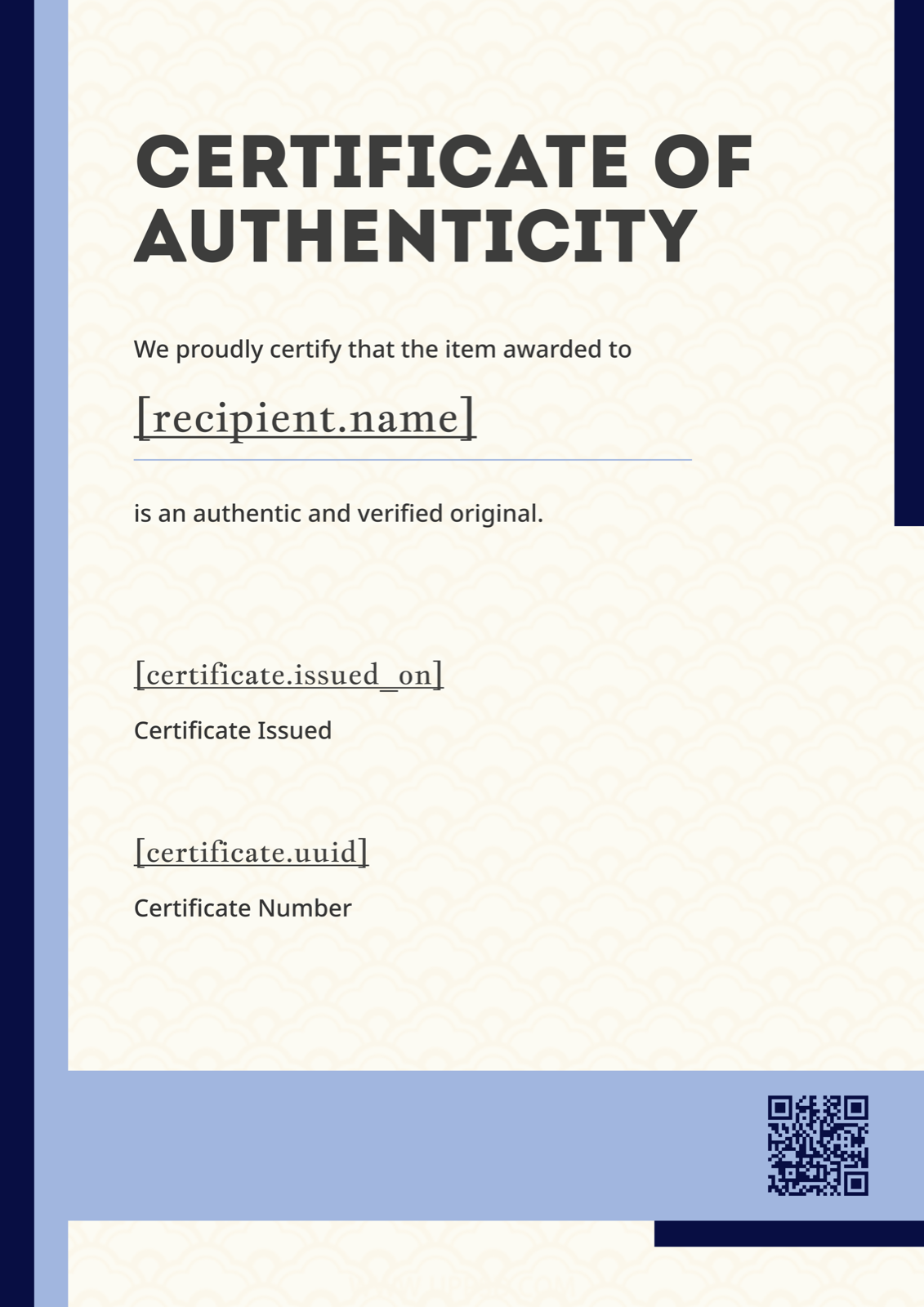
The portrait orientation and generous white space make this well-suited to certificates that carry a lot of item detail — medium, dimensions, edition notation, and a provenance statement all sit comfortably without crowding. Clean enough for contemporary galleries that don't want ornate borders competing with the work itself.
Classic Blue Border Certificate of Authenticity
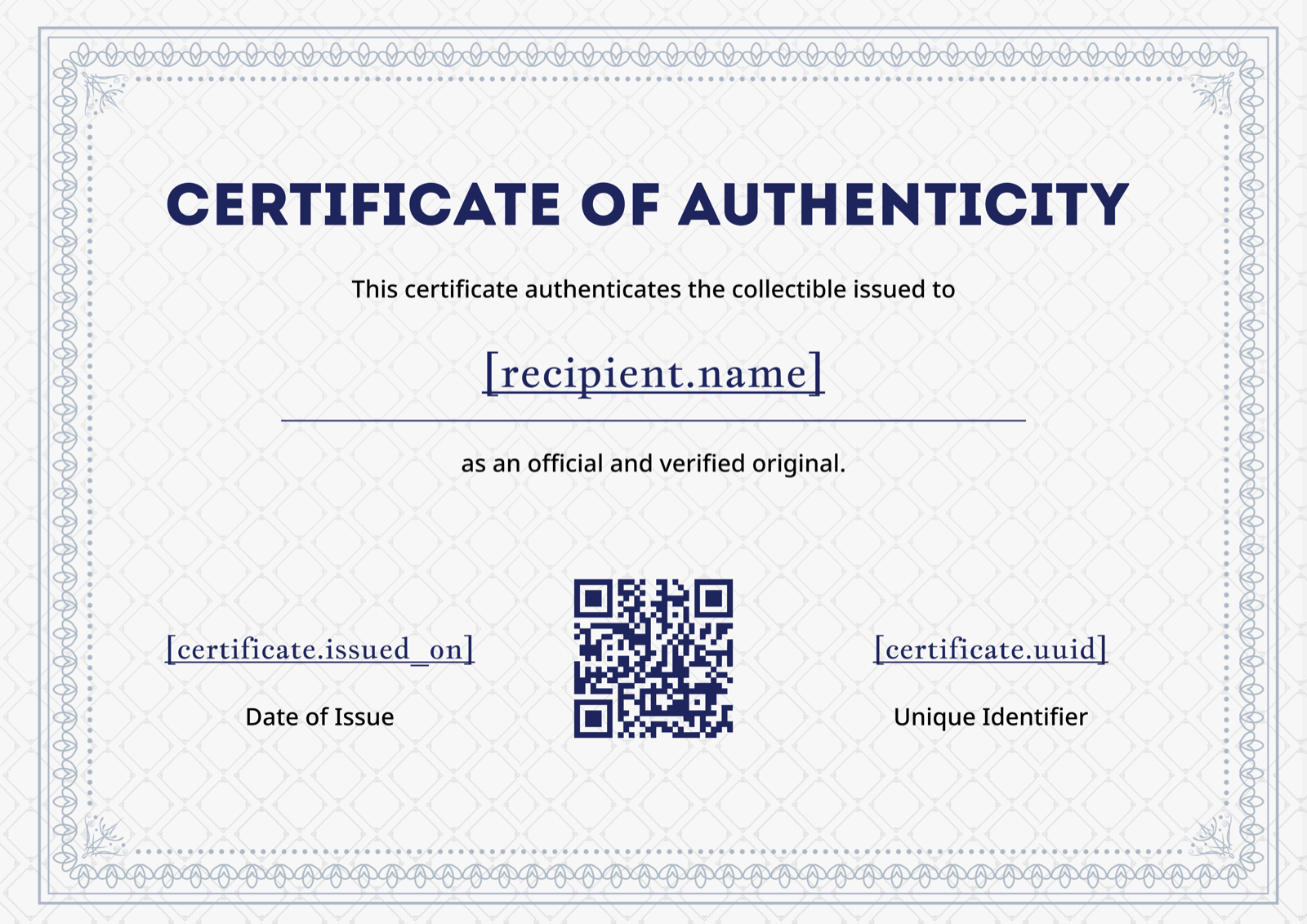
The ornate border and built-in QR code placement make this a strong choice when verification matters as much as presentation. Collectors and resellers can scan the QR code to confirm authenticity without contacting the issuer directly — useful for memorabilia and collectibles that change hands multiple times.
Modern Navy Geometric Portrait Certificate of Authenticity
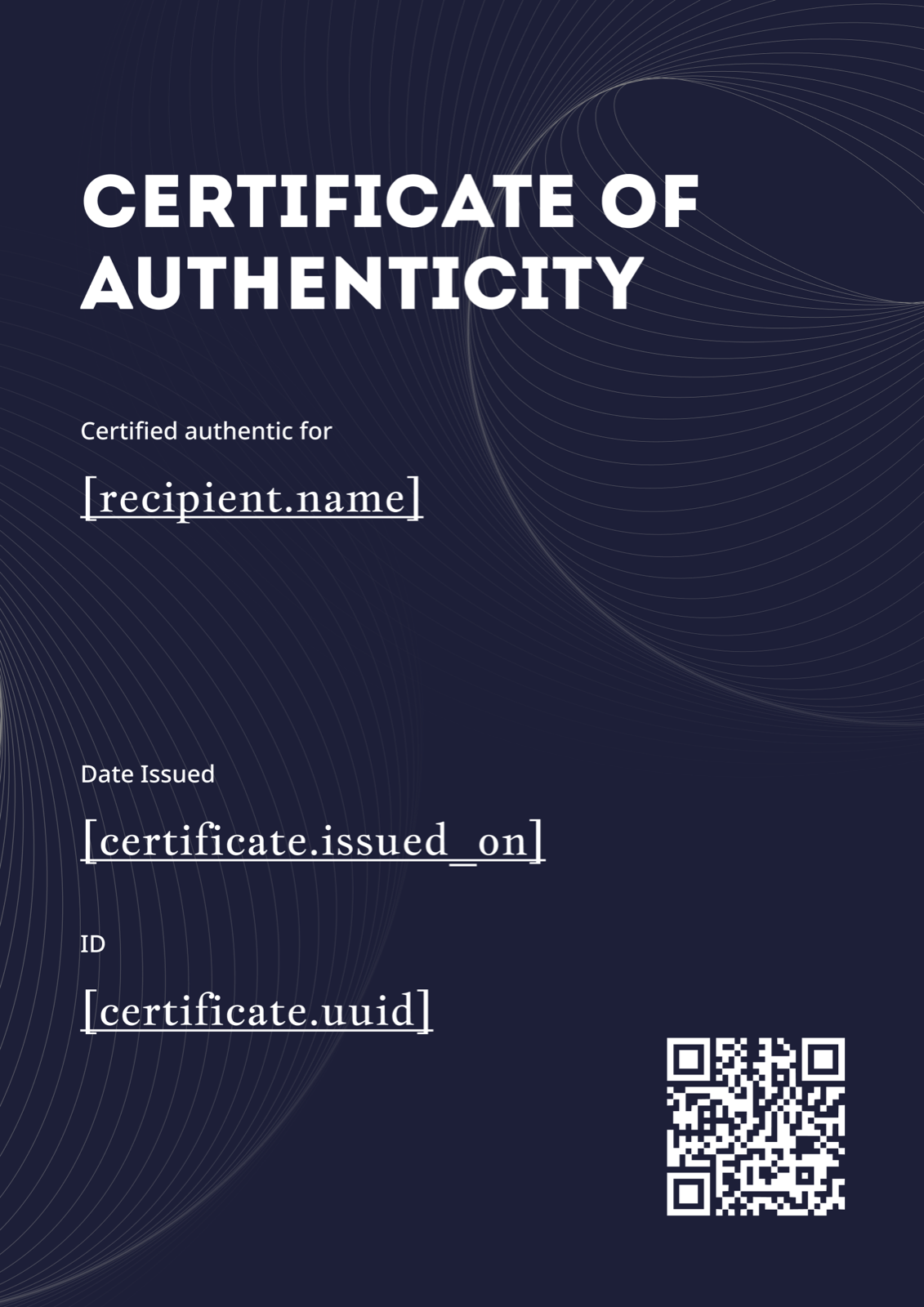
Dark backgrounds read as premium, and the geometric spiral detailing here adds visual interest without decorative clutter. Works particularly well for limited-edition print studios and product drops where the certificate is meant to feel like part of the product experience, not an afterthought.
Navy Blue Certificate of Authenticity
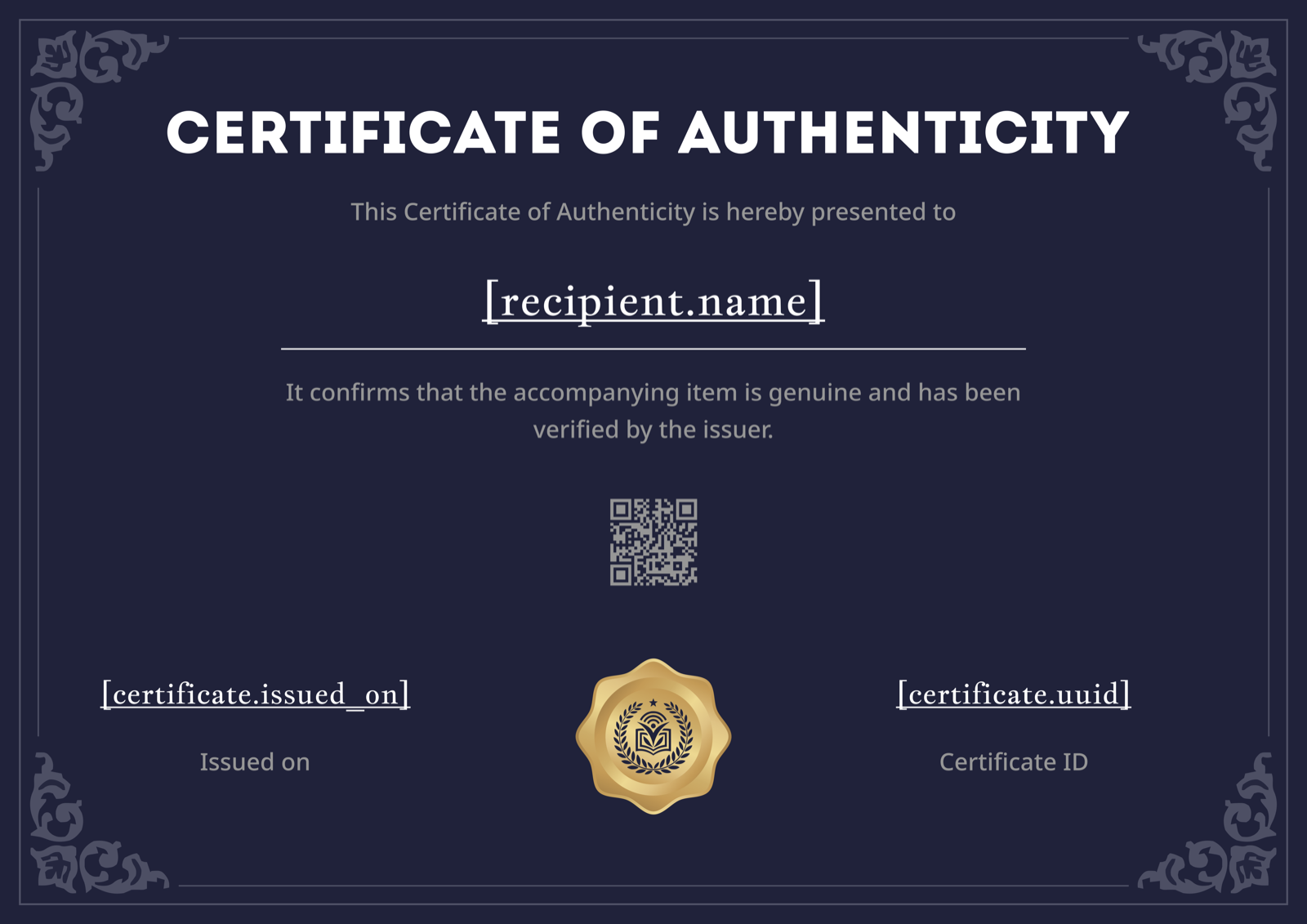
Corner ornaments and a gold verification seal give this template a classic authority that suits fine art, estate pieces, and any context where the certificate will be stored long-term alongside the work. The gold seal element echoes physical authentication conventions that serious collectors already trust.
For additional layouts, the best free Certificate of Authenticity templates roundup compares more options side by side.
Issuing: One-Off vs At Scale
For small batches, the step-by-step certificate creation guide walks through the manual process — download a template, customise each field, export as PDF. For an edition of 10 or 20, this is perfectly manageable. If you're sending physical copies with each piece, the certificate printing guide covers paper weight, finish options, and sizing.
For larger runs, doing this by hand breaks down fast. An edition of 250 means 250 unique certificates, each with a different edition number and reference code. CertFusion handles this by letting you upload a spreadsheet with your item data — title, edition number, serial reference — and generating every certificate automatically, each one correctly populated. For studios and galleries running multiple releases a year, that's the difference between a morning's admin and a week of it.
Tying Certificates to a Verification Registry
A certificate printed on paper is only as trustworthy as the issuer's reputation. For high-value works or collectibles that will change hands, linking the certificate to a verifiable record significantly increases its credibility with future buyers and auction houses.
The simplest approach is a reference number system: every certificate carries a unique code, and buyers can email you to confirm it. A step up from that is a QR code that links to a page where the item details are publicly listed — the Classic Blue Border template has a dedicated QR placement for exactly this. For volume issuers, CertFusion generates certificates with embedded verification links, so any buyer anywhere in the chain can confirm authenticity without involving you directly. This matters most for memorabilia and limited-edition prints, where the resale market is active and provenance questions come up years after the original sale.
Pick a template from the Certificate of Authenticity gallery, match it to your item type and audience, and issue something that will still hold up when the work is resold ten years from now.
Table of Contents
Related Articles
Discover more insights and stories that might interest you